Noah Okafor’s rise from erratic dribbler to one of Europe’s most efficient attackers has not surprised Dominic Calvert-Lewin, because the Leeds United forward identified both the problem and the potential within weeks of training alongside him.
Noah Okafor’s inclusion in the Switzerland squad for the 2026 World Cup is the clearest indication yet of how dramatically his reputation has changed during the 2025-26 season.
RATE Noah Okafor’s first season at Leeds United
He cost £18m.
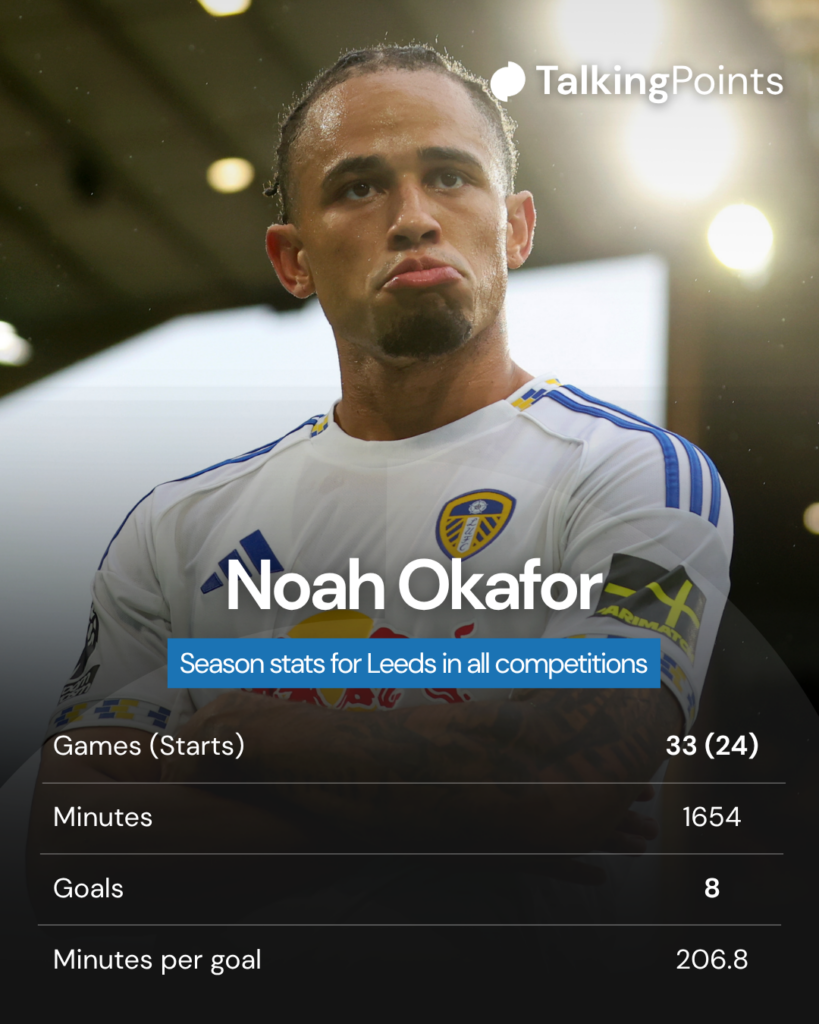
The Leeds attacker was statistically second only to Harry Kane in one key efficiency metric after scoring eight Premier League goals in just 1569 minutes. Since February, he averaged a goal every 68 minutes.
He did so while maintaining a conversion rate above 20%. Those are elite-level numbers for a player who spent the opening weeks of the campaign trying to adapt to the pace and demands of English football.
Calvert-Lewin recognised the flaw and the potential immediately
Calvert-Lewin’s assessment now reads like an accurate scouting report of the player Okafor would eventually become: “I remember it well, I think he signed a week after me. The season had just started.
“I was obviously happy to see a new recruit to strengthen. I remember his first sessions, his feet were so quick. That’s the first thing I remember, he was so quick and explosive and thinking, he has a lot of ability.
“It took him a couple of weeks to get used to a different tempo, the environment. He would dribble when it wasn’t the time to dribble, but he adjusted, it was like he would knock it and run past players with ease.

“He flourished. This season has all come together for him,” Calvert-Lewin told Okafor’s YouTube channel.
What makes the quote striking now is how closely it aligns with Okafor’s season. Calvert-Lewin identified the explosiveness immediately, but he also recognised that the forward needed quicker decisions and simpler choices before his talent would consistently translate into production.
Wolves exposed the exact flaw Calvert-Lewin described
One of the clearest examples arrived at Molineux earlier this season when Okafor lost possession at Molineux attempting to dribble out of trouble, allowing Wolves to score the opener.
Daniel Farke criticised Okafor’s decision-making at half-time before Leeds responded to secure a 3-1 win at Wolves. Looking back now, the moment perfectly reflected the learning curve Calvert-Lewin later explained in detail.
The finished version of Okafor is now emerging
The statistical profile suggests that adaptation has happened. Okafor is currently outperforming his xG, ranks in the 96th percentile for goals per 90 minutes, and is in the 98th percentile for dribbles attempted.
PROVE ME WRONG: Noah Okafor is Leeds’ most-effective player right now.
Gerrard thinks so.

The important detail is that Okafor has not stopped dribbling. He has simply become more selective about when to attack defenders and when to release the ball quicker.
That is exactly the progression Calvert-Lewin described from the start. The explosiveness was always there, but the decision-making needed refinement before the player could fully flourish.
The 2025-26 season now looks like proof that process is complete. Okafor’s numbers, his growing importance for Leeds, and his World Cup recognition with Switzerland all suggest Calvert-Lewin saw the finished version of the player long before everybody else did.
Receive a digest of our best Leeds content each week direct to your mailbox